


Deciding.
Understand your options. Think about your goals and the questions you want to ask.

Active Knee
Understand your knee. Explore resurfacing. Plan for the life you want to lead.
See how resurfacing worksWhat is resurfacing?
Active Knee starts with your anatomy and the activities that matter to you. Resurfacing uses implants to rebuild joint surfaces damaged by arthritis.
Knee resurfacing is a form of knee replacement. It requires bone preparation, implants, and recovery.
Compare how the knee is reconstructed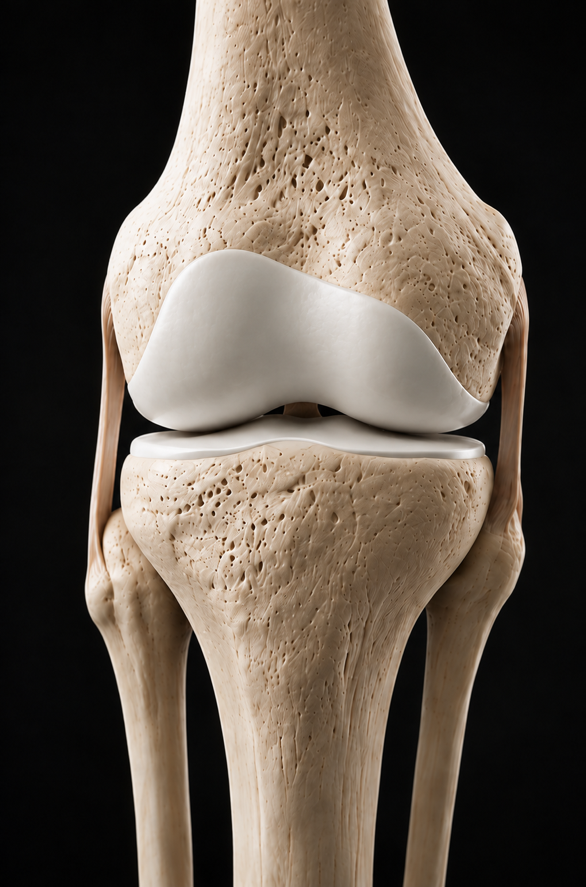
Smooth cartilage covers the ends of the bones.
Arthritis can leave bone exposed. Your surgeon removes the damaged cartilage and a small amount of underlying bone.
Metal components and a plastic spacer form the new joint surfaces. Your anatomy guides their placement.
Simplified educational illustrations. The images show cartilage, wear and implants; they do not show every surgical step.
How knee surfaces are replaced · AAOS ↗Planning the reconstruction
Your anatomy helps inform the plan. These examples show how joint position can change the relationship between bones and ligaments.
This example aims to recreate the pre-arthritis joint angle. Your surgeon selects the target for your knee.
Swipe to compare all three knees →
Loading anatomical models…
Native-angle aim
Your original joint angle
Neutral joint-line target
This example shows a native-alignment target alongside a neutral target. The appropriate choice depends on the clinical plan.
Swipe to compare all three knees →
Loading anatomical models…
Native-alignment aim
Your natural alignment
Neutral alignment target
Recreating the position of your joint surfaces helps preserve the natural relationship between your knee and its supporting ligaments.
Swipe to compare all three knees →
Loading anatomical models…
Balance in this model
Natural ligament balance
Changed balance during bending
The resurfaced and native knees keep the same illustrative ligament relationship. In the raised joint-line example, the inner ligament becomes looser during part of the bend.
Your anatomy.
Your surgical plan.
A balance to check through motion.
The middle knee is the pre-arthritis reference. These are illustrative surgical aims, not predictions of your result. Alignment refers to the knee’s front-view relationship, not a simulation of walking or weight-bearing.
The right-hand column shows conventional mechanical alignment in the first two rows and a raised joint-line example in the third. The third example combines changes in joint height and geometry; it does not represent every replacement or the effect of insert thickness alone. Ligament paths illustrate relative balance, not measured tissue tension.
These examples use implants to resurface bone. Different alignment strategies may preserve ligaments; the illustrations do not compare clinical outcomes. “Ligament sparing” here means aiming to preserve the collateral ligaments and their balance. ACL and PCL treatment depends on the implant and technique.
Joint-line height and ligament balance ↗Kinematic alignment research ↗
Your knee has its own shape and angles. Understanding them helps your surgeon plan your care.
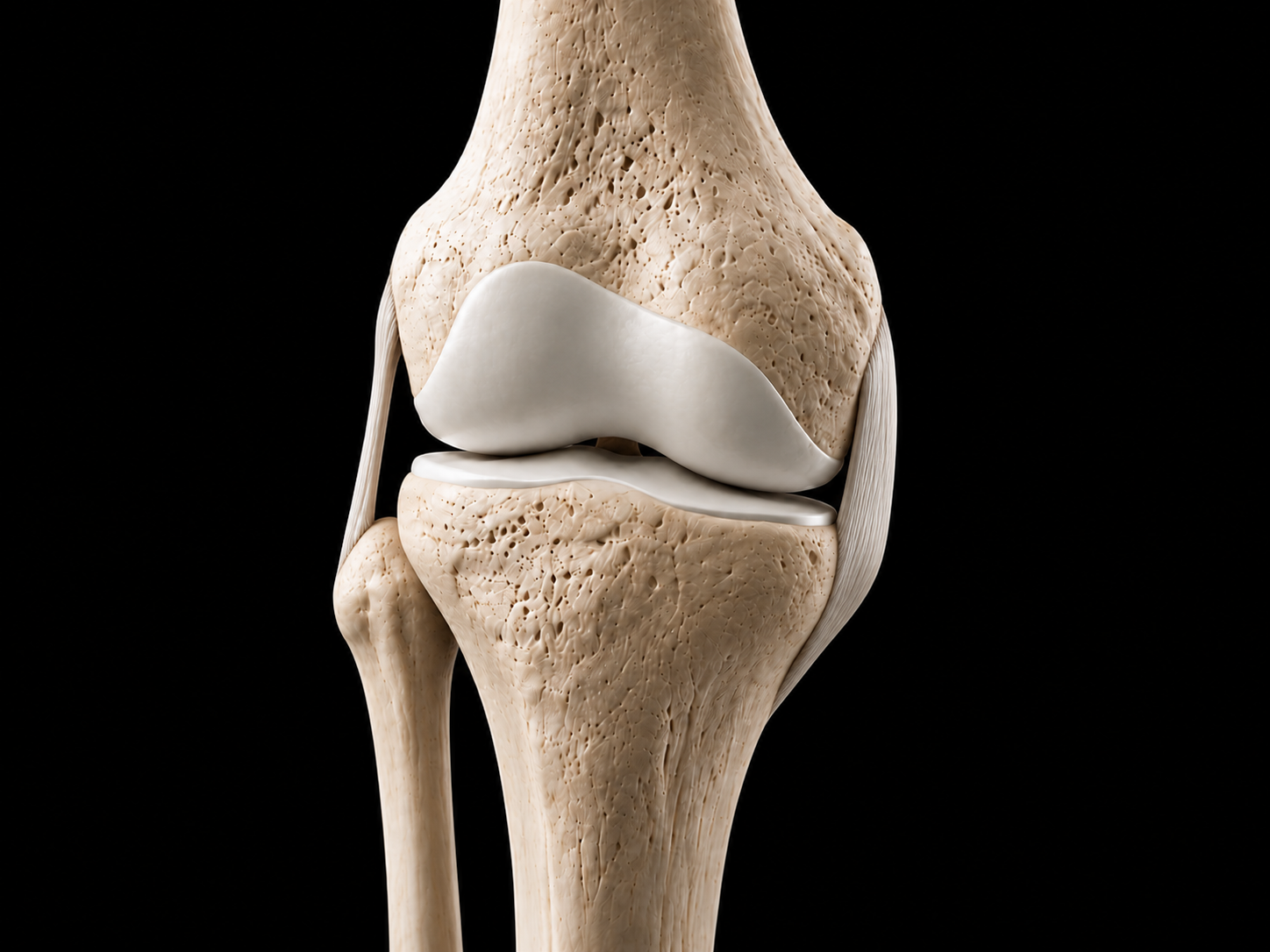
A natural range
Some legs naturally bow outward. Others are straighter or angle inward.
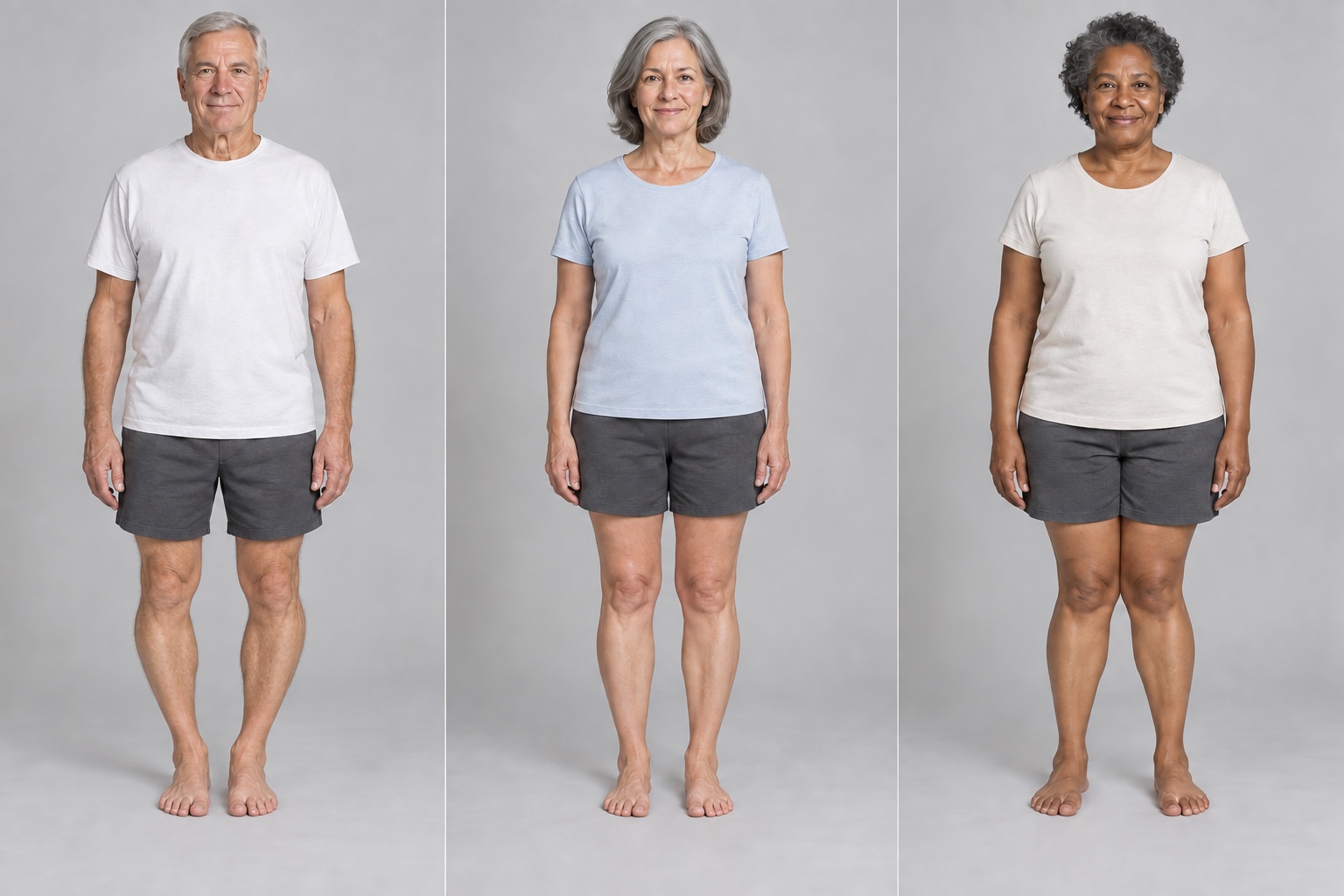
AI-generated illustrations of leg alignment. Not patient photographs or measurements.
01
Loading knee anatomy…
Neutral knee alignment and Neutral joint angle.
Illustrative anatomy. Based on CPAK ↗ · Native knee variation ↗
02
Your thighbone ends in two rounded surfaces. Their size, shape, and curves are unique to you.
Your femur also contributes to the angle of your joint.
03
The top of your shinbone (tibia) also has its own unique shape. Its surface and natural angle vary from person to person.
04
Your knee bends, glides and rotates. The outside moves farther backward than the inside as your knee bends. The inside of your knee stays more stable throughout motion.
Preparing the knee…
Illustrative 0–120° motion based on the phased pattern described by Iwaki et al. (2000). Individual knees and activities vary. Explore the evidence ↗
07
Three routes to the joint
Different routes can lead to the same reconstruction. The route alone doesn’t tell you how the implants will be positioned.
Beneath the inner quadriceps muscle, preserving the muscle and tendon
Loading anatomy…
Front view · surgical approach
01 / EXPOSURE
The approach is the route your surgeon takes through or around the tissues.
Different routes.
The same restoration goal.
Illustrative anatomical reference, not patient-specific planning or a prediction of motion. Resections are simplified; anatomy, exposure and ligament balance require surgical assessment.
Early recovery. Subvastus and midvastus approaches may offer modest benefits in the first few weeks, such as less pain, earlier muscle control, or more knee movement. Individual recovery varies. [1, 2, 3]
Later recovery. Early differences tend to fade. Studies have not consistently shown better longer-term function, movement, complication rates, or need for further surgery. [1, 3, 4]
The trade-off. Some approaches can make the joint harder to see, especially in larger or stiffer knees or after previous surgery. The approach should never compromise accurate implant placement. [1, 5]
The best approach allows your surgeon to safely and accurately reconstruct your knee.
Explore the knee approaches reference library · 802 articles →Evidence from total knee replacement studies.
08
A better conversation
Active Knee puts your goals at the center of the conversation. Resurfacing aims to rebuild worn joint surfaces. How your knee feels and which activities you can return to depend on your health, surgery, and recovery. Results vary.
Yes. Resurfacing describes replacing damaged joint surfaces with implants. Active Knee is our patient-facing name; Active Knee Resurfacing is the professional concept. Ask your surgeon which surfaces will be treated and which operation is right for you.
Yes. Your surgeon removes damaged cartilage and some underlying bone, prepares the surfaces, and secures the implants. The amount and the plan depend on your knee and the chosen procedure.
No single plan fits every person. Your surgeon considers your bone shape, supporting tissues, and overall health when choosing how to position the implants. Ask why that plan fits your knee.
The approach is how your surgeon reaches the knee. Reconstruction is how the damaged surfaces are replaced and the implants positioned. Different approaches can be used for the same reconstruction.
Jiffy Knee is a branded knee replacement offering. Its website describes an approach that preserves muscles and tendons by moving them aside to reach the joint.
When discussing surgery with your surgeon, ask two separate questions: How will you reach my knee? How will you reconstruct its joint surfaces and alignment?
Read Jiffy Knee’s description.
This website is not affiliated with, sponsored by, or endorsed by Jiffy Knee. The name is used solely to identify and discuss that offering.
Explore Active Knee Resurfacing: the anatomy, surgical decisions, and evidence behind the professional discussion.
JointVoyage
A place to decide, prepare, and follow your recovery.
Understand your options. Think about your goals and the questions you want to ask.
Get ready for surgery, plan for help at home, and know what to expect next.
Check in on how you feel, follow your progress, and keep your recovery story in one place.
Start before surgery. Keep checking in afterward to see how your pain, movement, and everyday life change over time.
Use JointVoyage alongside the instructions from your surgical team. Your check-ins describe your progress; they do not guarantee a result.
Your next step
Start a conversation about your knee.
6 surgeons to get to know
Loyola Medicine
Maywood, IL
2160 S First Avenue · 60153
Melrose Park, IL 60160
675 W North Avenue
Burr Ridge, IL 60527
6800 N Frontage Road
JIS Orthopedics
New Albany, OH
7277 Smith’s Mill Road, Suite 200 · 43054
St. Clairsville, OH 43950
45280 National Road W
Total Joint Specialists
Cumming, GA
2000 Howard Farm Drive, Suite 200 · 30041
Texas Hip & Knee Center
Fort Worth, TX
6301 Harris Parkway, Suite 300 · 76132
Fort Worth, TX 76244
10900 Founders Way, Suite 201
Rockhill Orthopaedic Specialists
Lee’s Summit, MO
120 NE Saint Luke’s Boulevard, Suite 200 · 64086
Blue Springs, MO 64014
600 NE Adams Dairy Parkway
Anderson Orthopaedic Clinic
Annandale, VA
3299 Woodburn Road, Suite 480 · 22003
Alexandria, VA 22306
2501 Parkers Lane, Suite 200
Reston, VA 20190
1886 Metro Center Drive, Suite 300
Oxon Hill, MD 20745
251 National Harbor Boulevard, Suite 303
Distances are approximate, straight-line estimates from ZIP or city locations. Confirm the office and available procedures with the practice. Location data: GeoNames.